
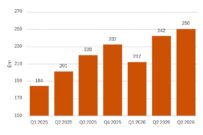
Semi-commercial mortgage lending increased by 14% year-on-year to £250m in the third quarter as more lenders entered the market, according to research from TAB.
The specialist lender’s Mixed-Use Mortgage Monitor shows lending increased 3% from the previous quarter and has grown 36% since Q1 2025, when quarterly advances stood at £184m.
The market is now lending at an annualised rate of £1bn for the first time since TAB began tracking it in Q1 2025, although actual lending during the latest four quarters totalled around £936m.
TAB says part of the Q3 increase reflects lenders that launched products during May and June beginning to complete business, alongside borrowers refinancing from bridging loans onto longer-term debt.
BRIDGING LENDERS MOVE INTO TERM FINANCE
The number of active semi-commercial term lenders reached 30 during Q3, compared with 25 at the start of 2025.
Two lenders entered during the quarter and none left, while the number of available products increased 5% from 94 to 99.
Duncan Kreeger (main picture, inset), Chief Executive Officer of TAB, says: “We’ve seen another two lenders, both rooted in bridging, moving into longer-term semi-commercial lending – these lenders want to keep hold of borrowers when they refinance away from bridging loans.
“In fact, the last quarter extended a run of new entrants. One lender arrived in late 2025, and another three launched semi-commercial ranges in Q2 2026.”
Source: TAB
However, Kreeger says the sector remains a specialist market despite the increase in competition.
“Even at 99 products, semi-commercial remains a specialist corner of the market. Borrowers typically have a fraction of the choice available to residential or standard buy-to-let borrowers, and many cases still need a broker who knows which lenders will consider a particular mix of commercial and residential space.”
FUNDING COSTS PUT PRESSURE ON RATES
The average headline fixed rate fell slightly from 6.70% in Q2 to 6.65% in Q3, despite new entrants pricing at up to 7.99%.
Average LTVs also slipped from 67% to 66.5%, while the average loan size fell 1% to £510,000.
TAB expects rising swap rates during September to feed through into specialist lender pricing during Q4, potentially slowing activity.
Kreeger adds: “Specialist lenders are likely to reprice upwards to reflect September’s swap-rate rise, reversing some of the summer’s cuts.
“On the plus side, September’s two entrants should begin to add completions in Q4 and Q1 2027, supporting competition.”
He says growth slowing from 20% in Q2 to 14% in Q3 means the final quarter will test whether newer entrants can maintain competitive pricing as their own funding costs rise.