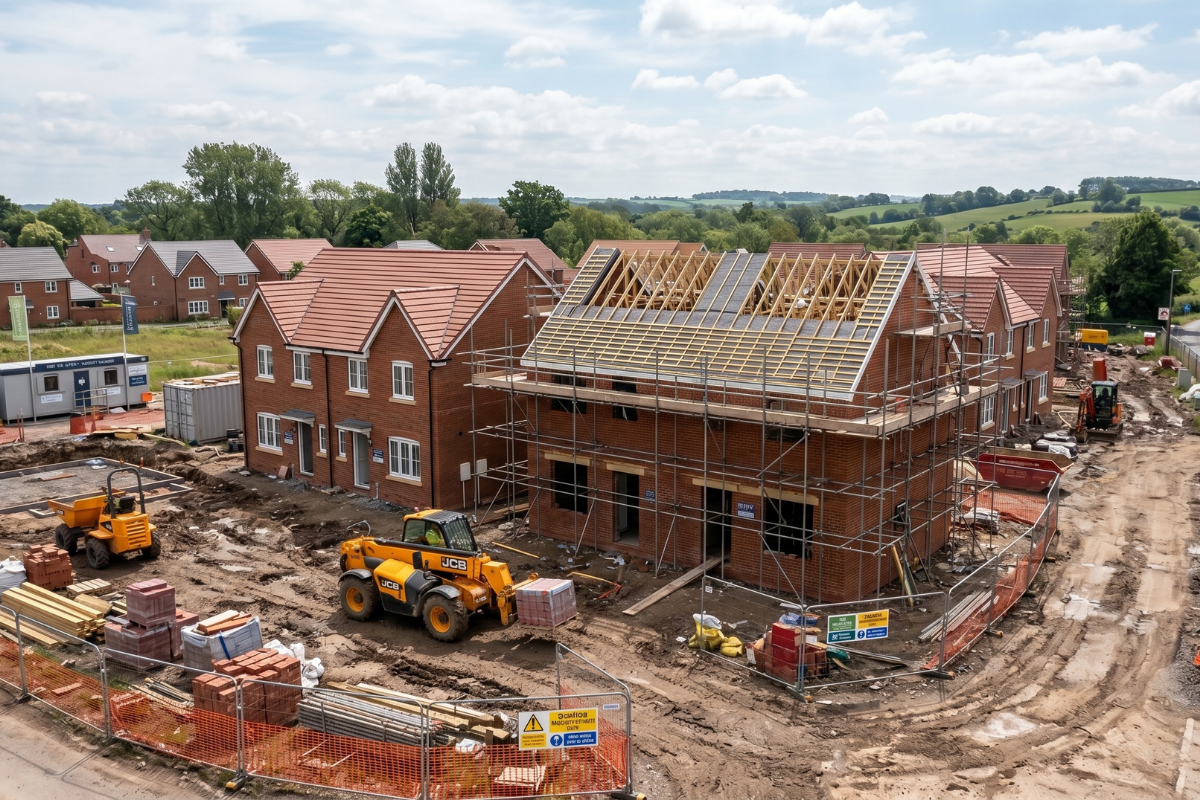
UK housebuilding activity fell sharply in August as the construction sector remained in contraction for a twentieth consecutive month, according to the latest S&P Global UK Construction PMI.
The headline Construction PMI fell from 44.7 in July to 44.3 in August, remaining below the 50.0 level separating growth from contraction.
However, the deterioration was concentrated in residential construction, where the index dropped from 41.8 in July to just 37.6 in August.
Housing was the only one of the three main construction categories to record a faster rate of contraction during the month, with firms reporting subdued demand and fewer new projects, particularly housebuilding starts.
Commercial construction proved more resilient, with its index improving to 47.8 and recording its slowest decline since January. Civil engineering rose to 40.5, representing its least marked contraction since March.
NEW ORDERS SHOW SIGNS OF IMPROVEMENT
Despite the deterioration in residential activity, there were some more encouraging signs further down the pipeline.
New orders continued to fall in August but did so at the slowest rate since September 2025.
S&P Global says businesses cited heightened risk aversion following the Middle East conflict and delayed decision-making among clients, although improvements in infrastructure work provided some support.
Employment across construction also continued to decline as companies responded to a shortage of new work and cost pressures, but the rate of job losses was the smallest since February.
Subcontractor usage increased for the first time in almost two years.
There was further relief on costs, with input price inflation easing to a six-month low despite continued pressure from fuel, transportation and raw material prices.
‘SHARP AND ACCELERATED DROP’

Tim Moore, economics director at S&P Global Market Intelligence, says: “UK construction companies experienced another solid reduction in output volumes, with a faster downturn in house building the main reason for a weaker overall performance during August. A sharp and accelerated drop in residential activity more than offset slower falls in the commercial and civil engineering sub-sectors.
“Sluggish demand conditions and low client confidence, combined with anxiety about the impact of the Middle East conflict, were again factors contributing to lower workloads across the construction sector. Total new business nonetheless decreased to the least marked extent for 11 months amid reports of support from transport infrastructure work and some pockets of vitality such as data centre roll outs and energy sector projects.
“Encouragingly, input price inflation eased to its lowest since February and supply chain performance was broadly stable. Softer overall inflation was recorded in August despite upward pressure on operating expenses from higher fuel bills, logistics costs and raw material prices.
“Business optimism was still subdued, as growth projections for the year ahead eased since July and were much weaker than historic trends. Concerns about geopolitical tensions, lacklustre domestic economic prospects and elevated borrowing costs were all noted as holding back confidence.”
“Housebuilding activity remains under significant strain.”

Kelly Boorman, National Head of Construction at leading audit, tax and consulting firm RSM UK said: “Today’s PMI data shows the construction sector remains challenged by supply chain volatility, alongside uncertainty around government infrastructure spend and project mobilisation.
“Housebuilding activity remains under significant strain, with private residential continuing to fall short. The government’s initial allocation of almost £10bn from the Social and Affordable Homes programme, announced in August, marks a welcome funding boost for housebuilders.
“However, concerns over demand for private residential activity continues to weigh on sentiment. Further government initiatives to help boost private residential demand, such as first-time buyer incentives, would therefore be welcome by the sector, and could go a long way to easing some of the pressures faced by housebuilders.”
“Even a scorching summer, which would usually boost activity, has been little help.”

And Thomas Pugh, chief economist at RSM UK, adds: “Today’s construction PMI marks the 20th consecutive sub-50 reading and confirms that the sector continues to struggle against a backdrop of higher energy prices, elevated market interest rates and persistent uncertainty over planning reforms.
“Even a scorching summer, which would usually boost activity, has been little help with the official data showing output falling for three consecutive months.
“We see little immediate relief for the sector as weaker real income growth and a sharp repricing in mortgage rates both weigh on demand. What’s more, refined products such as diesel have risen by far more than oil prices alone would suggest. Renewed tensions in Iran and limited global refining capacity are likely to keep builder’s margins under pressure for the rest of the year.”
“The good news is that the fiscal rules are much more generous to investment spending than day-to-day spending, which should give John Healey the space to embark on Andy Burnham’s ambitious housebuilding targets, in turn providing a tailwind to demand.”
“Something needs to be done to stimulate demand.”

Richard Pike, sales and marketing director at Phoebus Software, says: “This is a tough time for the UK housebuilding sector, and today’s figures are a reminder of just how tough. Builders are being squeezed from both sides – costs continuing to rise, while demand is stifled by affordability constraints and higher mortgage rates.
“Construction activity hit a six-year low back in May, and while it had started clawing back some ground over the summer, this fall shows how fragile that recovery really is.
“And the pressure is only building: gilt yields hit their highest level since 1998 this week, and oil prices are climbing again. Both add to the cost burden housebuilders are already struggling with.
“Bellway and Barratt Redrow have both called on the government to act – Bellway specifically wants an immediate stamp duty cut alongside a deposit support scheme for first-time buyers – but the new PM seems cool on the idea, and it remains to be seen whether he has the fiscal room to introduce it anyway.
“Something needs to be done to stimulate demand. Without it, supply will keep contracting in a downward spiral, and today’s figures are a warning sign of exactly that.”