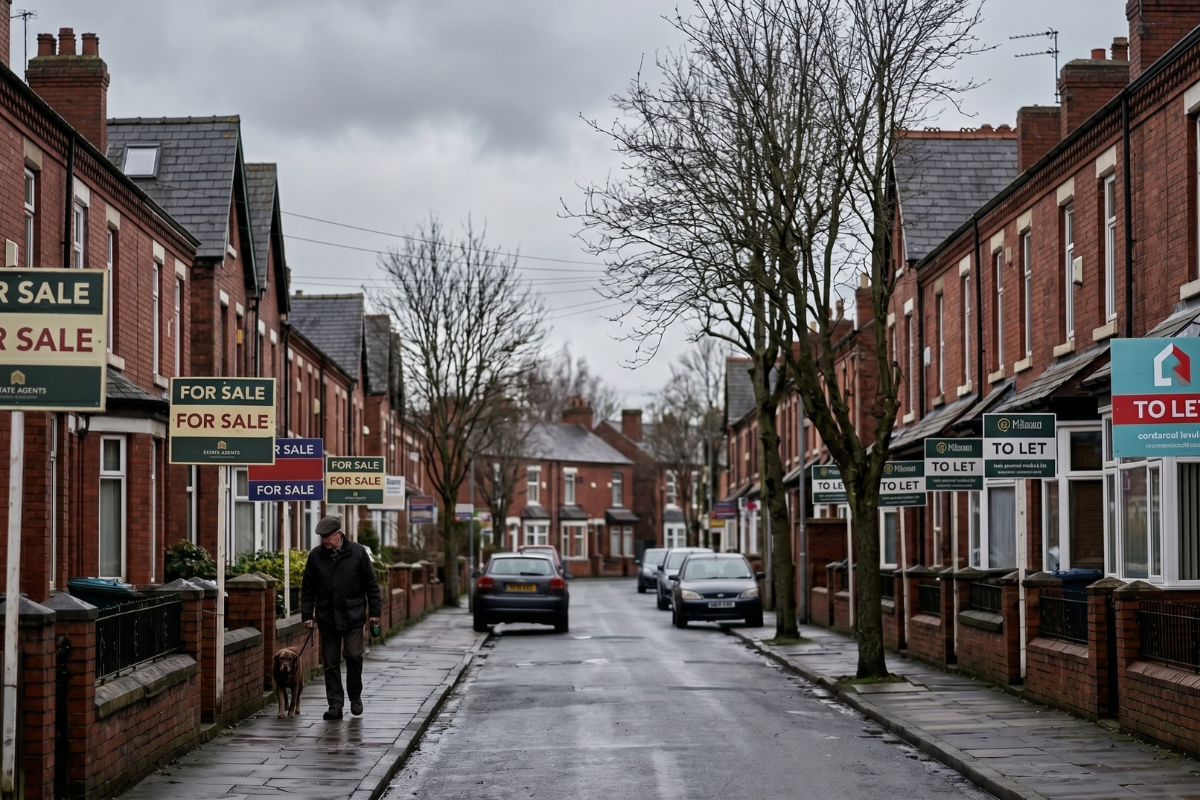
UK house price growth stalled in March as affordability pressures and higher mortgage rates continued to weigh on the market while rental inflation pushed higher again across much of the country.
Latest data from the Office for National Statistics showed average UK house prices were unchanged annually in March 2026, leaving the average property value at £268,000.
The flat annual reading marked a sharp slowdown from the 1.7% growth recorded in February and reflects increasing strain on buyer affordability following renewed mortgage rate volatility and wider economic uncertainty.
ONS data showed UK house prices fell by 0.4% between February and March, compared with a 1.2% monthly increase during the same period last year ahead of stamp duty changes introduced in April 2025.
REGIONAL VARIATIONS
House prices in England fell 0.6% annually to £290,000, while Wales recorded growth of 2.9% and Scotland continued to outperform with annual growth of 1.6%.
At the same time, rental inflation remained elevated. Average UK private rents increased 3.5% annually in April to £1,381 per calendar month, with the North East recording the strongest rental growth at 6.5%.
For the bridging and specialist finance market, the figures highlight a property sector increasingly shaped by affordability constraints, shifting landlord behaviour and changing investment strategies.
REDUCED EXPOSURE

Alex Upton, managing director, specialist mortgages and bridging finance at Hampshire Trust Bank, says: “Landlord strategy is continuing to change. We’re having far fewer conversations about expansion for the sake of growth, particularly as the Renters’ Rights Act starts feeding into longer-term investment decisions.
“Investors are looking much more closely at which properties still work financially, where income is more resilient and how portfolios need to evolve over the next few years.
“At the smaller end of the market, some landlords are choosing to reduce exposure where higher borrowing costs and tighter regulation have changed the economics of certain properties.
“More experienced investors are still active, but they are approaching opportunities differently. We’re seeing more interest in HMOs, mixed-use assets and properties where there is genuine scope to strengthen income over time, rather than simply adding units wherever possible.
“That shift is also changing the type of funding brokers are looking for.”
“That shift is also changing the type of funding brokers are looking for. More cases now involve capital raising, restructuring existing borrowing or repositioning portfolios around a longer-term plan. Lenders need to understand how those portfolios operate in practice, not just how they fit inside a standard set of criteria.
“What brokers and landlords need now is consistency. Where funding remains accessible and lenders continue to engage with more complex cases, confidence stays in the market and investment activity continues. That matters, because over time, confidence and availability play a major role in shaping the overall direction of the rental market.”
COST PRESSURES

Louisa Sedgwick, Managing Director of Mortgages at Paragon Bank, adds: “The conflict in Iran is building some further inflationary pressure into the economy and that will likely to be reflected in the rental market in the coming months.
“Landlords are not immune to cost pressures and 72% of those planning to increase rent in the next year will do so because of the rising costs they face in operating their business, with six in 10 citing a higher tax burden following the 2025 Autumn Budget.”
STALLED PRICES

Richard Donnell, executive director of research at Zoopla, says: “The ONS index shows house price inflation has stalled – this is a as result of Budget uncertainty over the taxation of housing in the latter part of 2025 as it’s too early for the higher mortgage rates of recent weeks to hit price changes this quickly.
“Looking ahead we expect house price inflation to continue to increase as buyer activity increases with clear evidence of growing sales and increased first time buyer activity as household press ahead with buying decisions. The year ahead is on track for 1.2m housing sales, only slightly lower than last year.”
UGENT SUPPORT NEEDED

Adrian Benosiglio, national real estate and construction corporate tax lead at RSM UK, says: “Today’s figures are yet another indicator of the urgent need for government support to help restimulate the UK housing market.
“The onset of the Iran war and subsequent economic impact marks a significant blow to a sector already facing numerous headwinds, including high levels of taxation, tight regulation, and UK economic volatility, with average house prices declining across many UK regions.
“Despite the official Bank of England base rate decreasing over the last year, mortgage rates are on the rise, significantly increasing borrowing costs for buyers and those remortgaging. This has delivered a concerning blow to market demand, as affordability and purchasing power becomes more constrained.
“The ongoing conflict in the Middle East, paired with broader economic uncertainty and continued political instability in the UK mean that the trend of subdued house price growth is likely to persist in the months ahead.
“Measures such as planning and tax reforms or further support for first time buyers could help to alleviate some of the challenges faced by the sector as it navigates a challenging economic backdrop in the months ahead.”