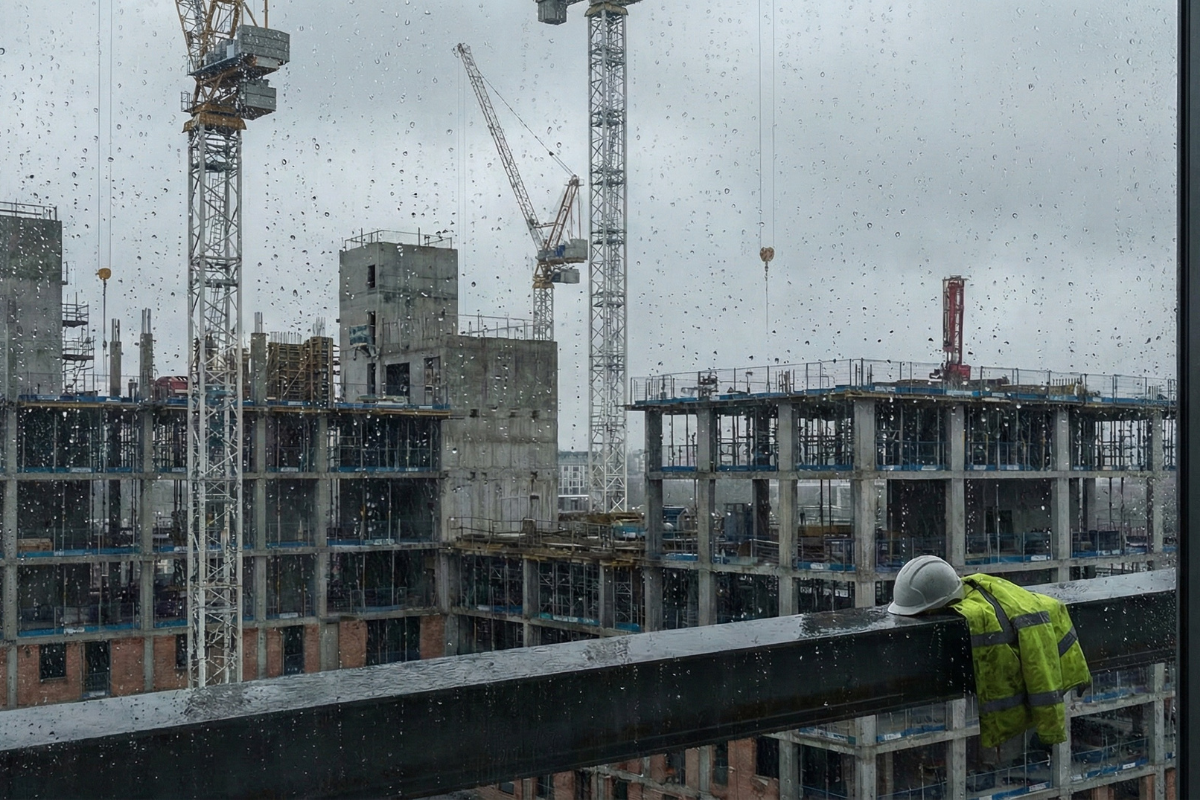
Construction output rose for a second consecutive quarter in the three months to April, driven largely by repair and maintenance work rather than new development.
The latest Office for National Statistics data showed total construction output increased by 1.6% over the period.
Repair and maintenance activity rose by 3.4%, while new work increased by a more modest 0.3%.
Six of the nine construction sectors recorded growth during the three months, with non-housing repair and maintenance making the largest contribution after rising by 3.5%.
On a monthly basis, construction output increased by 0.1% in April, following growth of 1.5% in March and 0.5% in February.
However, the figures suggest activity remains heavily reliant on refurbishment, maintenance and improvement work rather than new development projects.
Repair and maintenance activity increased by 0.6% in April, while new work contracted by 0.3%.
The data comes as developers continue to face higher financing costs, planning delays and uncertainty around the wider economic outlook.
For specialist lenders and brokers in the bridging and development finance sectors, the figures point to a mixed market. Construction activity is continuing to expand overall, but much of the growth is being generated by refurbishment and maintenance projects rather than large-scale new-build schemes.
The stronger performance of repair and maintenance may also reflect the focus on upgrading existing property stock, as landlords and investors prepare for future EPC requirements and seek to improve asset values through refurbishment.
NO GREAT SURPRISE
Neil Leitch, managing director of development finance at Hampshire Trust Bank, says: “A fall in private housebuilding will not come as any great surprise to those working across the sector. Just last week, S&P Global’s latest construction PMI showed the sector shrinking at its fastest rate in six years, which reflects the pressure developers are still working through across the market.
“When I speak to developers, the conversation is rarely about demand. Demand is there, but what’s missing is confidence.
“Developers are making long-term decisions whilst dealing with planning uncertainty, tighter viability and less flexibility once projects move into delivery, so it is little wonder output has slowed.
“The planning delays that have plagued the industry for years are still there, but now there is the added issue of unpredictability. Outcomes can vary significantly between authorities, and even well-prepared schemes can face uncertain timings and inconsistent decisions.
“That inevitably makes developers more cautious about how and when they commit capital. We are seeing developers place far greater emphasis on deliverability and realistic assumptions before schemes move forward.
“Land expectations have not always adjusted to reflect changing market conditions either, which means margins remain finely balanced across many schemes.
“We also need to remember that today’s output reflects decisions made months or even years ago. The bigger question now is what current conditions mean for the pipeline of schemes coming through tomorrow.
“In a market like this, certainty becomes increasingly important. Well-structured schemes supported by consistent capital and direct access to decision-makers are better placed to maintain momentum through delivery.”